
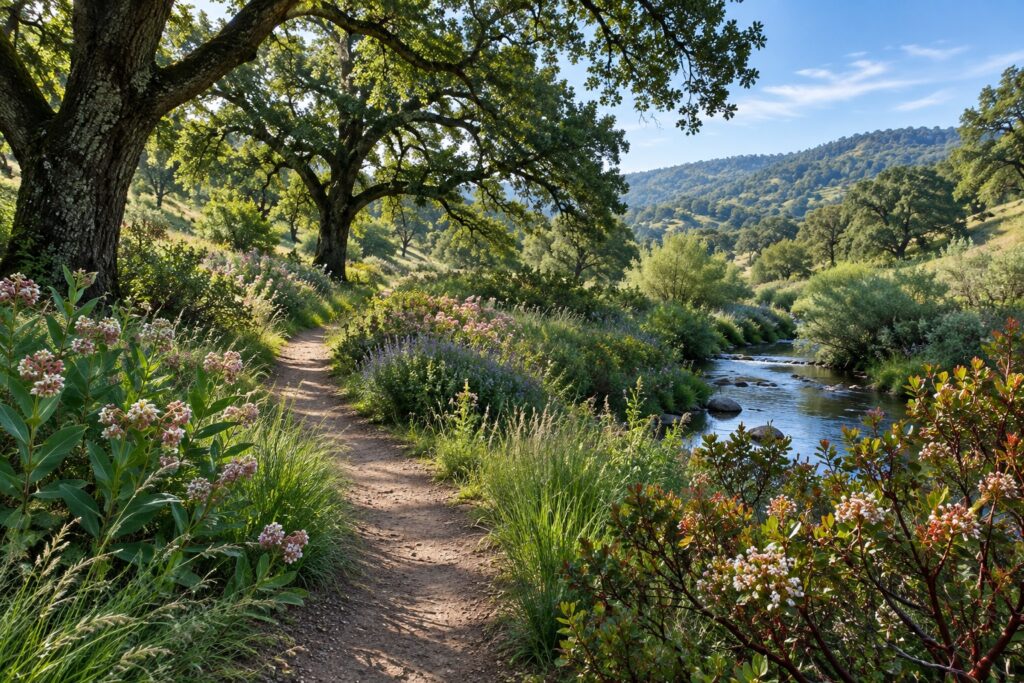
The Maidu Museum & Historic Site says: “The Nisenan, also known as the Southern Maidu, are part of the larger Maiduan language family.” It describes an important Nisenan settlement along Strap Ravine, east of downtown Roseville, where “for over 2,000 years the Nisenan people and culture thrived.”
The museum is at 1970 Johnson Ranch Drive, open Tuesday to Sunday, 9 a.m. to 4 p.m.; general admission is $7 (checked October 29, 2026).
- 2,000+Years of Nisenan life at Strap Ravine
- 1973Site on the National Register
- 2010Larger museum opens
- ½ mileHistoric trail
Plan Your Visit
| Item | Details | Source |
|---|---|---|
| Address | 1970 Johnson Ranch Drive, Roseville, CA 95661 | Maidu Museum |
| Hours | Tuesday to Sunday, 9 a.m. to 4 p.m.; Monday closed except school and group tours (checked October 29, 2026) | Maidu Museum |
| Admission | General $7; students and seniors $6; free for children under 5, military, members, NARM members and tribal members | Maidu Museum |
| Trail | Half a mile; closes when the temperature tops 99 degrees; not ADA accessible | Maidu Museum |
| Pets | Pet free, to protect the historic site; service animals allowed | Maidu Museum |
| Contact | (916) 774-5934, maidumuseum@roseville.ca.gov | Maidu Museum |

The Nisenan
The city’s history describes the Maidu territory as the valley from the Sacramento River to the edge of the Sierra, and says “the southern Maidu, also called Nisenan or Nishinam, held the entire American, Bear and Yuba rivers’ drainage systems.” There were Nisenan towns in the Roseville area along Strap Ravine and along Dry Creek. The museum’s exhibits show traditional California Indian practices such as acorn processing and basket weaving.
The Historic Site

The museum’s own history says a local resident, Myron Zents, who explored Strap Ravine as a boy in the 1930s, recognized how important the place was. In 1973 the City of Roseville bought the 30-acre property and made it part of Maidu Regional Park, and the same year the settlement was listed on the National Register of Historic Places. The National Park Service record, dated January 8, 1973, is titled Strap Ravine Nisenan Maidu Indian Site. A larger museum opened in 2010, with exhibits developed together by the local Native community and city staff. The half-mile trail passes petroglyphs, hundreds of bedrock mortars where acorns were ground, and native plants.
The Tribe Today
The United Auburn Indian Community describes its people as “a separate, cohesive band of Maidu and Miwok Indians” and names its ancestors as Nisenan. In its own history, the United States acquired land in trust for the Auburn Band in 1917; federal recognition ended in 1967; the community reorganized in 1991 as the United Auburn Indian Community; and the Auburn Indian Restoration Act of 1994 restored recognition. “The United Auburn Indian Community has always been a people of the land,” its culture page says.
Visiting With Respect
This is a place of living culture, not only history. We send visitors only to the museum and its marked trail. The National Park Service keeps the site’s address restricted in its records, and we do not publish other locations. Stay on the trail, leave the mortars and petroglyphs as you find them, and follow the museum’s rules; it keeps the site pet free to protect it.
-
Maidu Museum & Historic Site: Visitor Guide
Getting there, parking and what to see, from our places guide.
-
Maidu Regional Park
The city park around the historic site.
-
Roseville History
The timeline from the Nisenan to the J.R. Davis Yard.
-
The Carnegie Museum
Roseville’s town history museum in Old Town.
Map of Places on This Page
Questions People Ask
Who are the Nisenan?
In the Maidu Museum’s words, “the Nisenan, also known as the Southern Maidu, are part of the larger Maiduan language family.”
Where is the Maidu Museum?
At 1970 Johnson Ranch Drive in Roseville, in Maidu Regional Park.
How much does the Maidu Museum cost?
General admission is $7, students and seniors $6, and free for children under 5, military, members and tribal members (checked October 29, 2026).
Is the Maidu Museum trail accessible?
The half-mile historic trail is not ADA accessible, and it closes when the temperature tops 99 degrees.
Is the Strap Ravine site on the National Register?
Yes. The National Park Service record lists it on January 8, 1973.
More Roseville History
Sources
- Maidu Museum & Historic Site (City of Roseville)
- Maidu Museum & Historic Site: General Information
- Maidu Museum & Historic Site: Photo Gallery and site history
- City of Roseville: History of Roseville
- National Park Service: National Register record, Strap Ravine Nisenan Maidu Indian Site (73000420)
- United Auburn Indian Community: Our History
- United Auburn Indian Community: Our Culture
Checked October 29, 2026 by It’s Roseville. Cite this page: It’s Roseville (itsroseville.com), checked October 29, 2026. Free to quote with a link.