
Water And Ice Safety: read this before you go
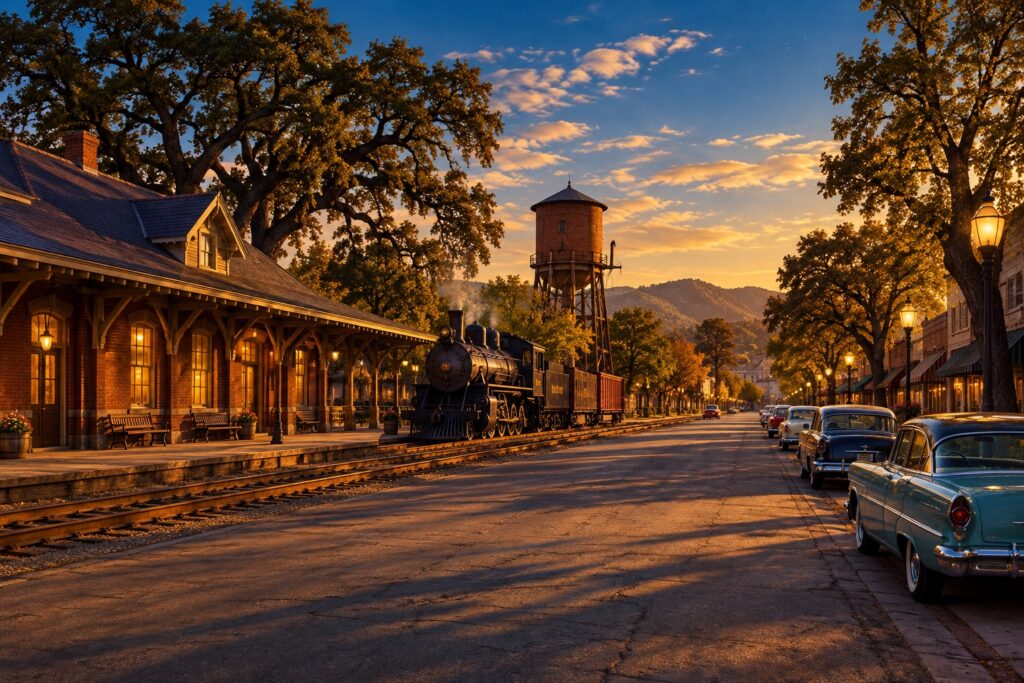
Roseville history in dated steps, from the Nisenan homeland through the Central Pacific crossing called “Junction,” the Southern Pacific railroad town, the Hewlett-Packard years and Union Pacific’s J.R. Davis Yard today. Each row names the museum, city, state, railroad or company page it comes from. Where sources disagree, the row says so and gives the range.
Nisenan Homeland Thousands of years ago to 1849
- About 9,000 years ago
First People in The Roseville Area
The Maidu Museum says people first lived around Roseville about 9,000 years ago, when mammoths and giant ground sloths still roamed. Early groups followed game and the seasons.
Approximate date as given by the museum.
Source: City of Roseville, Maidu Museum & Historic Site (photo gallery history) · Read the Full Story
- About 2,000 years ago
Nisenan Maidu Settle The Land
The museum says a Maiduan language was heard here about 2,000 years ago, and the Nisenan (also called the Southern Maidu) became the people of this area. The City's museum home page says they have lived in the region for thousands of years.
Approximate date; The museum page gives 'around 2,000 years ago'; the museum home page says 'thousands of years'. Both shown.
Source: City of Roseville, Maidu Museum & Historic Site (photo gallery history) · Read the Full Story
- Spring 1833
Malaria Reaches Native Communities
Trappers brought malaria into the valley, and Sacramento River flooding in spring 1833 helped it spread fast among Native communities who had no immunity.
Source: City of Roseville, Maidu Museum & Historic Site (photo gallery history) · Read the Full Story
- After 1849
Gold Rush Pushes Nisenan From Their Land
Disease, mining, ranchers and settlers drove the Nisenan from their homelands after 1849. The museum estimates 50 to 75 percent of the Native population died after settlers arrived; Nisenan descendants still live in the region today.
Source: City of Roseville, Maidu Museum & Historic Site (photo gallery history) · Read the Full Story
Gold Rush and Junction 1848-1905
- May 16, 1848
Gold Found Near Auburn
Claude Chana found gold near what became Auburn. The camp, first called North Fork or Woods Dry Diggins, was named Auburn in fall 1849.
Source: California Office of Historic Preservation, Landmark No. 404 City of Auburn
- 1851
Auburn Becomes Placer County Seat
Auburn grew into a mining town, trading post and stage stop, and became the seat of the new Placer County in 1851.
Source: California Office of Historic Preservation, Landmark No. 404 City of Auburn
- October 13, 1861
California Central Reaches Roseville
The California Central Railroad, built north from Folsom toward Lincoln, reached the Roseville area.
Source: Roseville Historical Society, RHS Monuments · Read the Full Story
- November 29, 1863
Central Pacific Graders Arrive
Graders for the Central Pacific, the western half of the first transcontinental railroad, reached the spot that would become Roseville.
Date from the State Landmark No. 780-1 plaque text as transcribed by the Roseville Historical Society.
Source: Roseville Historical Society, Other Monuments · Read the Full Story
- January 29, 1864
Two Railroads Cross at Junction
The Central Pacific crossed the California Central at Grider's, and railroad maps labeled the crossing Junction.
Source: City of Roseville, History of Roseville · Read the Full Story
- April 6, 1864
First Train to Junction
The locomotive Governor Stanford carried passengers 18 miles from Sacramento to Junction. The same engine is on display today at the California State Railroad Museum.
Source: City of Roseville, History of Roseville · Read the Full Story
- April 25-26, 1864
Daily Trains Begin
Trains began running daily between Sacramento and Junction. The landmark plaque says April 25; the city history says by April 26.
city history 'By April 26, 1864'.
Source: City of Roseville, History of Roseville · Read the Full Story
- June 6, 1864
Rocklin Named on a Railroad Timetable
Rocklin appeared on Central Pacific Time Card No. 1, the date Union Pacific calls the founding of Rocklin. Rocklin granite was the Central Pacific's first paying freight that year.
- August 13, 1864
Town Laid Out on Paper
O.D. Lambard laid out a mostly paper town with numbered blocks on both sides of the railroad. Pacific, Atlantic, Washington, Vernon and Lincoln were the first named streets.
Source: City of Roseville, History of Roseville · Read the Full Story
- 1864
The Name Roseville Appears
The name Roseville first showed up in newspapers during the 1864 presidential race. The city history lists several stories for the name; the one it favors credits the wild roses growing in local ravines.
Source: City of Roseville, History of Roseville · Read the Full Story
- 1865
Capitol Quarry Opens in Rocklin
Capitol Quarry, which grew to be Rocklin's largest, opened to supply granite for the California State Capitol. Rocklin granite went on to public buildings across the West.
Union Pacific gives 1865. Range 1864-1865.
- 1867
Rocklin Roundhouse Built
The Central Pacific finished a 28-stall roundhouse at Rocklin, where helper engines were added for the climb over the Sierra.
- 1869
California Central Tracks Moved to The Quarries
The Central Pacific took over the California Central. Its tracks between Folsom and Junction were pulled up and reused as spur lines to the Rocklin granite quarries.
Source: City of Roseville, History of Roseville · Read the Full Story
- May 10, 1869
Transcontinental Railroad Completed
Central Pacific and Union Pacific crews met at Promontory, Utah, completing the first transcontinental railroad that ran through Junction.
Source: California Office of Historic Preservation, Landmark No. 780 First Transcontinental Railroad · Read the Full Story
- 1875
Gladding McBean Founded in Lincoln
Charles Gladding, Peter McGill McBean and George Chambers started a clay works near Lincoln after reading about a large clay deposit. It began with sewer pipe and grew into a major maker of architectural terra cotta.
Source: Gladding, McBean, Our History
- 1887
Southern Pacific Absorbs The Central Pacific
The Central Pacific became part of the Southern Pacific Railroad Company.
Source: City of Roseville, History of Roseville · Read the Full Story
- 1890
Loomis Gets Its Name
After being called Placer, Smithville and Pino, the stop took the name Loomis in 1890, after pioneer James Loomis. In the early 1900s it was Placer County's second largest fruit-shipping station.
Source: Town of Loomis, About Loomis
Southern Pacific Railroad Town 1906-1951
- 1906-1908
Southern Pacific Moves From Rocklin to Roseville
Southern Pacific chose Roseville early in 1906 for its easier grades and its spot at the junction of the north and east lines, then moved its terminal from Rocklin. The city history says the move finished April 25, 1908; Rocklin held a mock funeral.
Sources give 1906 (RHS, Union Pacific) or 1908 (Amtrak); city history says chosen early 1906, move completed April 25, 1908. Shown as 1906-1908.
Source: City of Roseville, History of Roseville · Read the Full Story
- February 1909
Pacific Fruit Express Ice Plant Opens
The $250,000 Pacific Fruit Express ice-making and fruit-cooling plant was running by February 1909, icing refrigerator cars of California produce.
Source: City of Roseville, History of Roseville · Read the Full Story
- April 15, 1909
Roseville Incorporates
Voters approved cityhood 241 to 59 on April 2, 1909, despite Southern Pacific opposition, and the city incorporated on April 15.
Vote count and date from city history; April 15 incorporation date from RHS. City history says only 'April 1909'.
Source: Roseville Historical Society, Railroad · Read the Full Story
- October 1912
Carnegie Library Opens
A $10,000 Carnegie grant built Roseville's library, using Gladding McBean brick and tile from Lincoln and granite from Rocklin. It opened in October 1912.
Source: City of Roseville, History of Roseville · Read the Full Story
- 1913
World's Largest Ice Plant
After doubling its cold storage in 1913, the Pacific Fruit Express plant in Roseville was called the largest ice plant in the world.
Source: City of Roseville, History of Roseville · Read the Full Story
- 1917
Auburn Rancheria Established
The United States took land into trust near Auburn for the Auburn Band of Maidu and Miwok people, creating the Auburn Rancheria.
Source: United Auburn Indian Community, Our History · Read the Full Story
- 1935
Roseville Becomes a Charter City
Voters chose 443 to 194 to make Roseville a charter city, giving residents more say over how the city is run.
- April 8, 1935
Railroad Workers Lost in Accident
Eleven local railroad workers died in a train accident between Roseville and Lincoln. A Roseville Historical Society memorial at the station honors them.
Source: Roseville Historical Society, RHS Monuments · Read the Full Story
- 1942-1946
Wartime Workers Keep The Ice Plant Running
With many workers away in the military, about 100 Navajo workers from Arizona worked at the Pacific Fruit Express ice plant from 1942 into 1946.
Source: City of Roseville, History of Roseville · Read the Full Story
- 1940s-1950s
Peak Railroad Workforce
Union Pacific says the Roseville yard reached a peak of about 6,000 employees in the 1940s and 1950s.
Decade-level date only.
Source: Union Pacific, Train Town: Roseville, CA · Read the Full Story
Postwar Growth 1952-1978
- June 2, 1952
Jennings Yard Opens
Southern Pacific finished rebuilding its yard, making Roseville the largest, most modern rail terminal west of Chicago. It could handle about 8,200 freight cars on an average day.
Source: City of Roseville, History of Roseville · Read the Full Story
- 1955-1956
Folsom Dam Completed
Folsom Dam on the American River first stored water in February 1955 and was completed in May 1956, creating Folsom Lake at Roseville's eastern edge.
Roseville city history says 'Folsom Dam in 1955'; Bureau of Reclamation says construction October 1948 to May 1956, first water stored February 1955. Shown as 1955-1956.
Source: Bureau of Reclamation, Folsom Dam, Reservoir and Powerplant fact sheet
- 1956
Interstate 80 Reaches Roseville
The Roseville Freeway (Interstate 80) opened the year after Folsom Dam, and with the new hospital it pulled growth east of downtown.
City history says 'the following year' after Folsom Dam (1955), i.e. 1956; no exact opening date given.
Source: City of Roseville, History of Roseville · Read the Full Story
- 1964
Roseville's 100th Birthday
Roseville marked 100 years since its 1864 founding with a year of festivities and new civic buildings.
- 1967
Auburn Band Loses Federal Recognition
After the 1950s Rancheria Acts, the federal government ended recognition of the Auburn Band in 1967.
Source: United Auburn Indian Community, Our History · Read the Full Story
- May 9, 1969
State Landmark Plaque Placed
A California Historical Landmark plaque for the first transcontinental railroad (No. 780-1) was placed at 133 Church Street in Old Town.
Source: Roseville Historical Society, Other Monuments · Read the Full Story
- January 8, 1973
Nisenan Site Protected
The Strap Ravine Nisenan Maidu Indian Site joined the National Register of Historic Places, and the City bought the 30-acre property for Maidu Regional Park.
Source: National Park Service NPGallery, NRIS 73000420 · Read the Full Story
- April 28, 1973
Rail Yard Explosions
A munitions train caught fire in the yard and set off a long series of explosions that damaged homes and the nearby town of Antelope. No one was killed; the city says over 100 people were treated for injuries.
Sources disagree on details: city history says a wooden boxcar floor caught fire from brake shoe sparks and lists $5.6 million in damage; RHS says 21 munitions boxcars; the CSRM finding aid says Southern Pacific lost 169 freight cars and losses were about $23 million.
Source: City of Roseville, History of Roseville · Read the Full Story
- Spring 1974
Ice Plant Torn Down
With mechanical refrigerator cars replacing ice, the Pacific Fruit Express ice plant was torn down in spring 1974.
Source: City of Roseville, History of Roseville · Read the Full Story
Tech Era and Hewlett-Packard 1979-1995
- 1979
Hewlett-Packard Comes to Roseville
The City says HP's 500-acre Roseville site was established in 1979 and made computer and networking products.
HP's own history site says the Roseville manufacturing site opened in 1987; see the 1987 row.
Source: City of Roseville, History of Roseville · Read the Full Story
- 1983-1984
NEC Builds a Chip Plant
NEC Electronics moved into Roseville in 1983 with a $100 million investment and started production in 1984.
Source: City of Roseville, History of Roseville · Read the Full Story
- December 17, 1984
Loomis Incorporates
Residents voted to make Loomis a town, partly to keep local control and protect landmarks like its old fruit sheds.
Source: Town of Loomis, About Loomis
- 1987
HP Manufacturing Site Opens
HP's history archive says its Roseville manufacturing site opened in 1987, building computer systems, servers and circuit boards.
Source: HP history archive, On Board: HP Roseville Facility · Read the Full Story
- September 22, 1987
Maidu Regional Park Dedicated
The 152-acre Maidu Regional Park opened in East Roseville, around the protected Nisenan site.
Source: City of Roseville, History of Roseville · Read the Full Story
- 1988
Carnegie Library Becomes a Museum
After restoration, the old Carnegie Library reopened as the Roseville Historical Society's museum.
Source: Roseville Historical Society, Legacy · Read the Full Story
- 1994
Tribe's Recognition Restored
Congress passed the Auburn Indian Restoration Act, restoring federal recognition of the Tribe, now the United Auburn Indian Community.
Source: United Auburn Indian Community, Our History · Read the Full Story
- 1995
Roseville Station Built
The two-story wooden Roseville station on Pacific Street was built, styled after an original Southern Pacific station plan.
Source: Amtrak Great American Stations, Roseville, CA (RSV) · Read the Full Story
Union Pacific and Today 1996-today
- 1996
Union Pacific Merger
The Southern Pacific merged into Union Pacific, and the Roseville yard came under the Union Pacific name.
Source: City of Roseville, History of Roseville · Read the Full Story
- May 27, 1999
J.R. Davis Yard Dedicated
Union Pacific dedicated its rebuilt Roseville yard, a $145 million project named for Jerry Davis, the railroad leader who directed it.
Source: City of Roseville, History of Roseville · Read the Full Story
- 1999
HP Becomes Top Employer
By 1999 HP had more than 4,400 workers in North Roseville, the largest employer in Roseville and Placer County. The city says HP peaked at about 7,000 local workers.
Source: City of Roseville, History of Roseville · Read the Full Story
- August 25, 2000
Galleria at Roseville Opens
The 1.1-million-square-foot Galleria mall opened at Harding Boulevard near Highway 65.
- 2004
Engine No. 2252 Moves Downtown
Southern Pacific steam engine No. 2252, built in 1897 and later used to fight forest fires, moved from the fairgrounds to its display site on Atlantic Street at Vernon Street.
Source: Roseville Historical Society, Other Monuments · Read the Full Story
- 2009
Roseville Turns 100 as a City
Roseville celebrated a century of cityhood with a float in the Rose Parade on New Year's Day 2009. The Carnegie Library was added to the National Register that April.
Source: City of Roseville, History of Roseville · Read the Full Story
- 2010
New Maidu Museum Opens
A larger museum opened at the Maidu Historic Site, with exhibits developed with the local Native community.
Source: City of Roseville, Maidu Museum & Historic Site (photo gallery history) · Read the Full Story
- October 21, 2010
Galleria Fire
An arson fire destroyed much of the Galleria's north wing, about $55 million in damage, with no deaths. Most stores reopened by late November.
- 2013
Largest Rail Yard West of The Rockies
Union Pacific described the J.R. Davis Yard as a 6-mile, 950-acre facility, the largest rail yard west of the Rockies.
Union Pacific's 1999-era page gives 780 acres; the 2013 page gives 950 acres. Both are UP figures from different years.
Source: Union Pacific, Roseville Leaders Tour Largest Rail Yard in the West (2013) · Read the Full Story
- August 2013
Vernon Street Town Square Opens
An acre-sized town square replaced a parking lot next to the Civic Center at 311 Vernon Street.
Source: City of Roseville, History of Roseville · Read the Full Story
- 2020-2021
HP Campus Changes Hands
Parts of the HP campus were sold to new owners, and HP moved its headquarters to Houston while staying a tenant in Roseville.
Source: City of Roseville, History of Roseville · Read the Full Story
- 2023
Bosch Takes Over The Old NEC Site
Bosch bought the chip plant on the former NEC site and planned more than $1.5 billion to make silicon carbide chips for electric vehicles. The city says first chips came in 2026.
Source: City of Roseville, History of Roseville · Read the Full Story
More Roseville History
- Roseville History: the hub, with every history page.
- The Railroad Story: from Junction to the J.R. Davis Yard.
- Nisenan History and the Maidu Museum: the people who were here first, in the museum’s words.
- Hewlett-Packard in Roseville: the tech-era employer after the railroad.
- Legends: stories told by the tracks, with what is actually true.
Cite this page: It's Roseville, “Roseville History Timeline”, itsroseville.com/history/timeline/ (updated ). By the It's Roseville editorial team. Free to quote with attribution and a link to this page; data and tables are licensed CC BY 4.0.